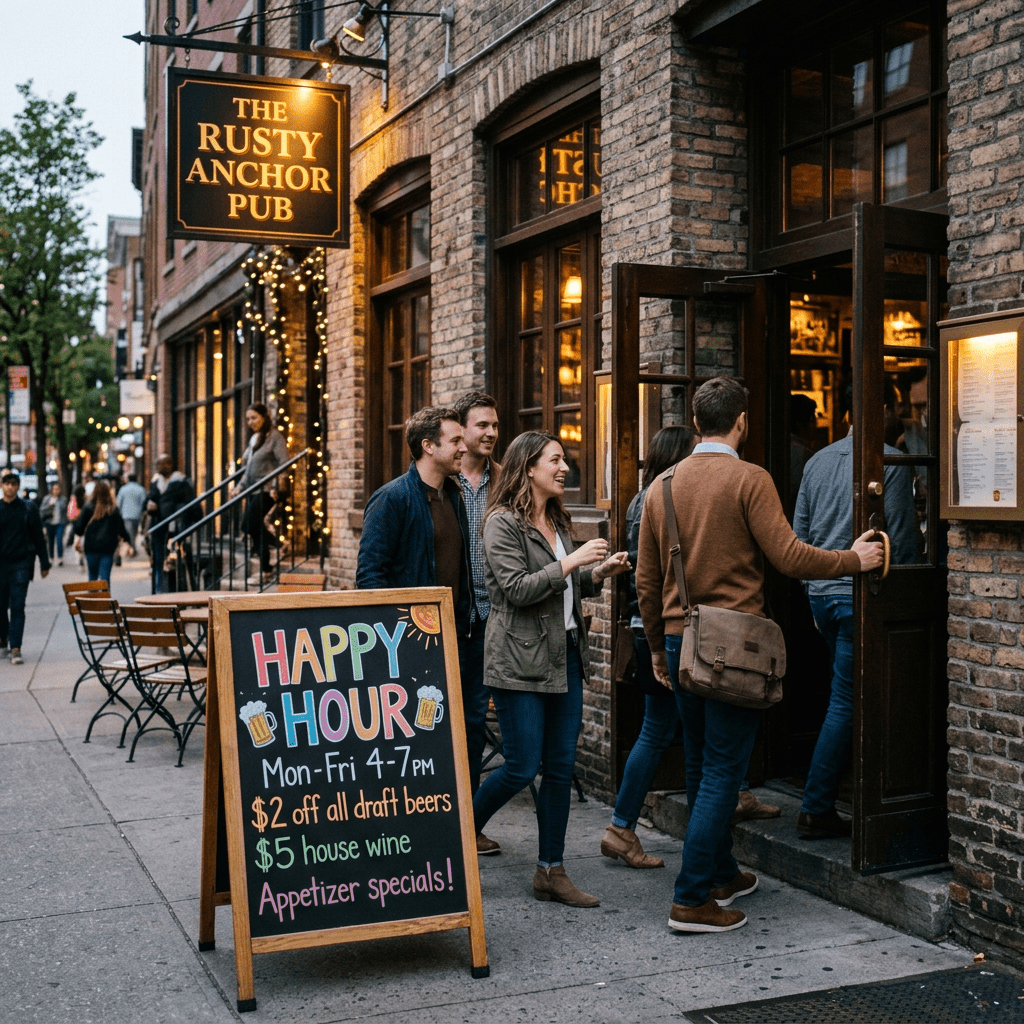
It all begins enough. You are walking home from work. You spot a chalkboard sign advertising half-price wings and four dollar drafts from four to seven PM. This sounds like a deal so you head inside and you place your order. The manager in the back is pleased because everything is going just as planned at the bar.
Happy hour is not about being generous to customers at the bar. It is actually a way for the bar to make money. To see why the bar uses this strategy it helps to know three concepts that economists have studied for years: price discrimination, consumer surplus and elasticity of demand at the bar.
Price discrimination is something that happens all the time at the bar. It means that different people pay prices for the same thing at the bar based on how much they are willing to pay for it at the bar. Consumer surplus is the difference between what you would have paid for something at the bar and what you actually paid for it at the bar. Businesses like the bar want this difference to be as small as possible because that means they get to keep more of the money from the customers at the bar. Elasticity of demand is about how peoples willingness to buy something at the bar changes when the price changes at the bar. Some people are very sensitive to the price at the bar while others do not really care about the price at the bar.
Happy hour at the bar is an example of all three of these things. It happens every day at the bar. It is like a game that the bar plays with its customers at the bar.
- The people who come to the bar at five PM are often different from the people who come to the bar at eight PM.
- The early crowd at the bar is usually looking for a deal because they are on a budget or they just want to grab a drink before they go home from the bar.
- The later crowd at the bar is often there for an occasion, like a date or a celebration. They are not as worried about the price at the bar.
The bar is not giving you a discount just because it likes you. The bar is using a price to get customers who would not normally come to the bar. If the bar charged eight dollars per drink it would lose all the customers looking for a deal at the bar. If it charged four dollars per drink it would lose money from customers to pay more at the bar. Happy hour at the bar solves this problem by charging one price for the crowd and another price for the crowd at the bar.
Let us say there is a bar that has one hundred customers. Half of them would pay up to nine dollars for a beer at the bar. The other half would only pay up to five dollars for a beer at the bar. If the bar charges nine dollars for every beer it will only sell fifty beers. Make four hundred fifty dollars. If it charges five dollars for every beer it will sell one hundred beers. Make five hundred dollars. If it charges five dollars during hour and nine dollars at night it will sell fifty beers at each price and make seven hundred dollars. That is a forty percent increase in revenue from pricing things at the bar.
This is not something that just the bar does. You see it everywhere once you start looking.
- Movie theaters have prices for showings.
- Stores have discounts for seniors and students.
- Hotels charge prices on weekends and weekdays.
- Airlines charge business travelers more than they charge people who are just going on vacation.
- Amazon charges its Prime members differently than it charges customers.
- Gyms have prices for peak and off-peak hours.
Even streaming services do this. Netflix charges more for plans that let you watch on screens at the same time because it knows that people who need that feature are probably wealthier and less worried about the price.
Is this fair? That is a question. If businesses could charge every person what they’re willing to pay that would be great for the businesses but it might not be so great for the customers. It is like a game, where the businesses are trying to figure out how much they can charge without losing customers.
In some cases this can be a problem. For example if a company is charging people more for something they need like medicine or rent that can be unfair. When it comes to something like a beer on a Tuesday most economists would say that happy hour at the bar is a thing. The people who are looking for a deal get to have a beer that they might not have been able to afford and the bar gets to make some money that it might not have made otherwise.
The important thing to remember is that prices are not numbers. They are choices that businesses like the bar make based on what they think their customers will pay. You as a customer have the power to make choices too. You can decide when to buy things and how much you’re willing to pay. It is like a game that you play with the businesses. It is happening all the time.
So when you go to hour at the bar remember that you are not just saving money. You are playing a role in a game that involves buyers and sellers. You are helping to determine the prices that businesses, like the bar charge. You are winning. The bar is winning too. That is how things are supposed to work in a market.